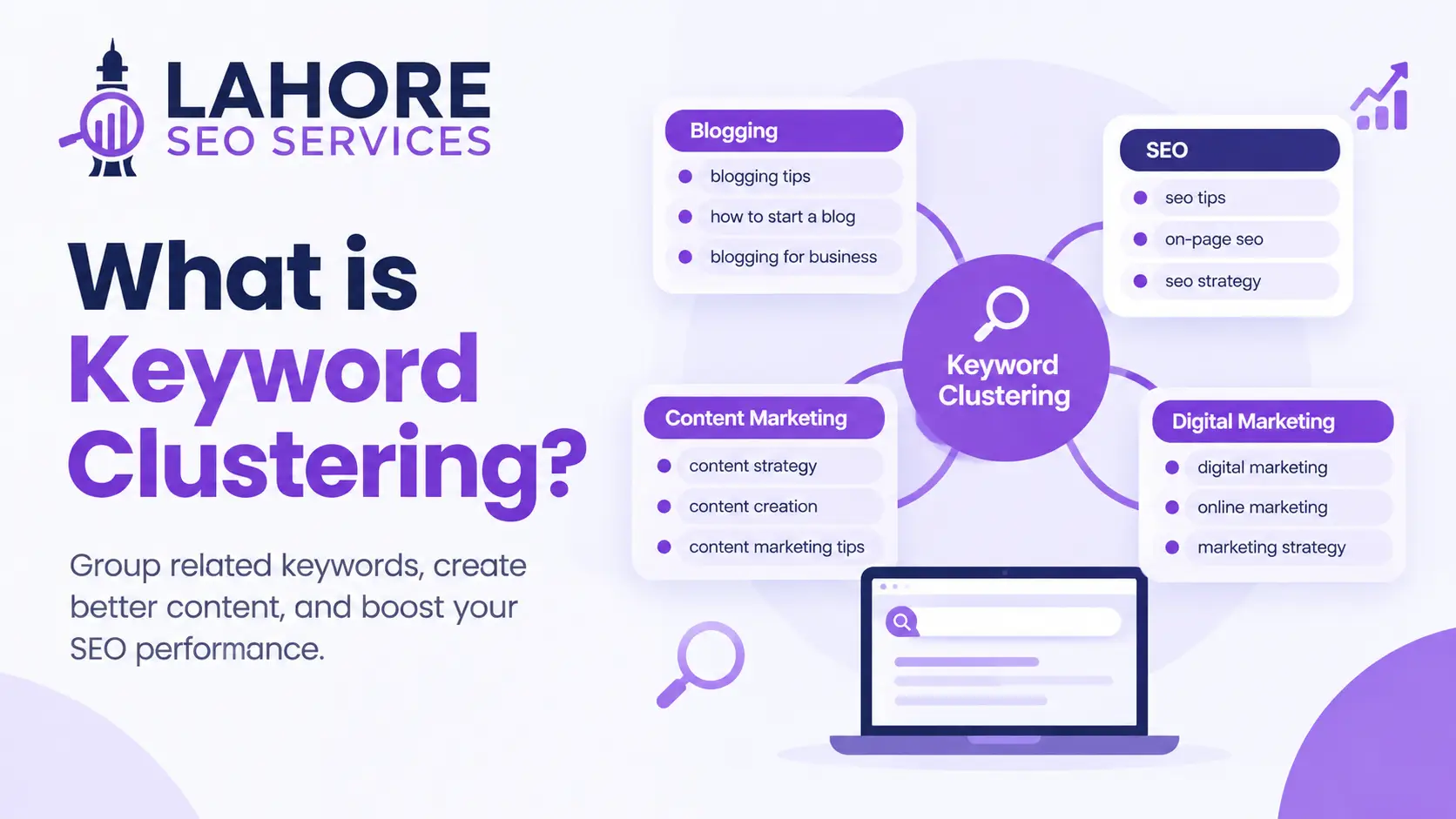
Keyword clustering is the effective SEO process of grouping related search queries that share search intent, semantic meaning, or similar search engine results pages (SERPs) so you can target them with the right pages. Instead of creating a separate page for every small keyword variation, you organize related terms into useful groups and assign each group to one content asset. Keyword clustering in SEO helps you build clearer content plans, reduce keyword cannibalization, strengthen internal linking, and cover a topic comprehensively.
For example, “keyword clustering,” “SEO keyword clustering,” and “keyword grouping” may belong to one cluster when the same type of page satisfies the searches. However, a query that requires a product page should not share a cluster with a query that requires an informational guide. The goal is not to collect similar words. The goal is to identify searches that can be satisfied by the same page.
Why Is Keyword Clustering Important?
Keyword clustering improves SEO planning because one cluster connects keyword research with a specific content decision. A cluster identifies related queries and the appropriate page.
Keyword clustering does not mean placing every related phrase on one page. Search intent remains the main decision factor. A page should remain focused on one clear user task.
What Does Keyword Clustering Mean?
Keyword clustering meaning is simple: group keywords that represent the same user intent and can reasonably be targeted by one page. Semantic similarity can help identify possible relationships, but search intent and SERP similarity provide stronger evidence for important publishing decisions.
Consider these example queries:
| Keyword | Likely intent | Page decision |
| keyword clustering | Informational | One guide |
| SEO keyword clustering | Informational | Same guide when SERP intent matches |
| keyword clustering examples | Informational | Same guide or dedicated examples section |
| keyword clustering tool | Commercial | Potentially separate tool-focused page |
| how to do keyword clustering | Informational | Same guide when the SERP overlaps |
The grouping depends on the target market and current search results.
How Does Keyword Clustering Work?
Keyword clustering works through a repeatable process that starts with research and ends with page mapping. You collect relevant queries, clean the data, classify intent, compare SERPs, create clusters, assign owner URLs, and monitor performance after publication.
1. Build a Keyword List
Start with a seed topic and collect related search queries through keyword research from Google Search, Google Keyword Planner, Google Search Console, competitor pages, customer questions, and SEO platforms such as Ahrefs, Semrush, or Moz.
Keep useful fields such as keyword, country, language, search volume, keyword difficulty, current ranking URL, clicks, impressions, and search intent. Long-tail keywords can reveal specific questions and needs that broad terms do not show.
Google autocomplete, People also ask, Related searches, and competitor content can expand the initial list. Export the results into a spreadsheet before clustering so you can review the full dataset consistently.
2. Clean and Normalize the Data
Remove duplicates, irrelevant locations, unrelated brand terms, and keywords that do not match the website’s audience or services. Do not automatically merge singular and plural variations. Check whether the search results and user intent actually match.
3. Classify Search Intent
Search intent describes what the searcher wants to accomplish. Four common categories are informational, navigational, commercial, and transactional.
Informational searches seek knowledge, such as “what is keyword clustering.” Commercial searches investigate options, such as “best keyword clustering tool.” Transactional searches indicate an action or purchase, while navigational searches seek a specific website or destination.
Different intentions often require different page types. A guide, comparison, category page, product page, and tool page should not be combined simply because the keywords share vocabulary.
4. Check SERP Similarity
SERP analysis validates whether keywords actually produce similar search results. Compare the ranking URLs for priority queries in the target country and language.
If two keywords repeatedly show many of the same organic results, the queries may belong to one cluster. If the results differ substantially, separate pages may be more appropriate even when the keywords sound similar.
SERP similarity is especially important for valuable clusters because Google’s ranking results provide evidence about how the search engine currently interprets each query.
5. Choose the Primary Keyword
Choose a primary keyword that clearly represents the page’s core intent. Search volume can inform the decision, but volume alone should not determine the primary term.
For this article, “keyword clustering” represents the central topic, while phrases such as “keyword clustering examples,” “keyword clustering in SEO,” and “how to do keyword clustering” support related aspects of the same informational task.
6. Assign One Owner URL
Every cluster should have a clear owner URL. Create a new page when no suitable URL exists, update an existing page when the page already satisfies the intent, or merge and redirect overlapping pages when multiple URLs compete for the same search need.
This step connects keyword research with site architecture. It prevents your content strategy from producing several pages that answer essentially the same question.
Keyword Clustering Examples
A practical keyword clustering example shows why search intent matters more than wording alone.
Suppose an SEO website has this keyword list:
- keyword clustering
- SEO keyword clustering
- keyword grouping
- keyword clustering examples
- keyword clustering tool
- keyword cannibalization
- topic clusters
- content hubs
The first five terms may appear related, but they do not automatically belong to one cluster. “Keyword clustering,” “SEO keyword clustering,” and “keyword grouping” can support one informational guide when the SERP confirms similar intent. “Keyword clustering tool” may require a commercial page focused on software options. “Keyword cannibalization” deserves a separate diagnostic resource, while “topic clusters” and “content hubs” may form separate strategic topics.
A useful cluster map could look like this:
| Cluster | Primary keyword | Related terms | Page type |
| Keyword clustering guide | keyword clustering | SEO keyword clustering, keyword grouping | Informational guide |
| Clustering examples | keyword clustering examples | clustering use cases, keyword group examples | Examples guide or section |
| Clustering tools | keyword clustering tool | keyword grouping tool, SEO clustering software | Commercial page |
| Cannibalization | keyword cannibalization | SEO cannibalization, competing pages | Diagnostic guide |
| Topic architecture | topic clusters | content hubs, pillar pages | Strategy guide |
This structure keeps separate user jobs separate while allowing natural internal links between related pages.
How Do You Create Keyword Clusters?
To create keyword clusters, collect a broad keyword set, clean the data, classify intent, compare SERPs, and map each validated cluster to a page. You can perform the process manually in a spreadsheet or use automated clustering tools to accelerate large datasets.
A hybrid method combines semantic grouping for speed with SERP analysis for validation. This approach reduces manual work without treating automated output as a final publishing decision.
Keyword Clustering vs Topic Clusters
Keyword clustering and topic clusters are related but different concepts. A keyword cluster groups related queries for a page, while a topic cluster organizes multiple pages around a broader subject.
A topic cluster usually contains a pillar page and supporting articles connected through internal links. Keyword clustering can help determine which queries belong on each supporting page before the broader content hub is built.
For example, an SEO website may use “search engine optimization” as a broad topic, with supporting pages for technical SEO, keyword research, content strategy, and SERP analysis. Each supporting page can have its own keyword cluster.
How Keyword Clustering Supports Content Strategy
Keyword clustering turns keyword research into a practical publishing roadmap. A cluster can become a new article, an updated service page, a category page, a product page, a subsection, or an FAQ depending on the intent and existing site structure.
A strong SEO content brief should identify the primary keyword, related keywords, target location, search intent, page type, unique angle, H1, supporting headings, internal links, external sources, and relevant structured data.
Do not write a page merely because a keyword has search volume. Confirm business relevance and audience value first. A cluster can attract searches without supporting the website’s services, products, or commercial goals.
How Keyword Clustering Prevents Cannibalization
Keyword clustering helps prevent cannibalization by assigning one owner URL to each search intent before content production begins. Keyword cannibalization occurs when multiple pages target substantially the same search need and compete for visibility.
When two pages overlap, review their H1s, headings, content purpose, ranking queries, and internal links. You may need to merge pages, redirect one URL, differentiate the intents, or keep both pages with clearer roles.
Google Search Console can reveal which queries trigger each URL. Regular query-to-page reviews help you identify unexpected overlap and determine whether the content map needs adjustment.
Keyword Clustering Tools
Keyword clustering tools can automate parts of the research and grouping process. Common SEO platforms include:
- Ahrefs, Semrush, Moz, Surfer, and specialized keyword grouping tools.
- Google Keyword Planner and Google Search Console provide valuable keyword and performance data.
- Screaming Frog can support site-level URL and content analysis.
Common Keyword Clustering Mistakes
The first mistake is clustering by words alone. Similar wording does not guarantee identical intent.
The second mistake is ignoring geography. Search results can differ between countries, so clustering for Pakistan, the United States, the United Kingdom, or another market should use the relevant SERP.
The third mistake is creating one giant page for every related keyword. A comprehensive page should still satisfy one clear user task. Mixed intents often require separate URLs.
The fourth mistake is publishing without an owner URL map. Define page ownership before writing so new articles do not unintentionally compete with existing content.
The fifth mistake is forcing every secondary keyword into the copy. Natural language matters more than mechanical repetition. Use related terms when they clarify the subject or answer a real user question.
How to Monitor Keyword Clusters
Monitor keyword clusters after publication through Google Search Console and your preferred SEO platform. Review impressions, clicks, ranking queries, landing pages, and changes in search visibility.
A page that gains impressions for relevant variations may need stronger internal links, clearer sections, or improved conversion elements. A page that ranks for an unexpected intent may need content expansion or a clearer separation from another URL.
Review clusters periodically because search results and user behavior can change. Keyword clustering is not a one-time spreadsheet task; the cluster map should remain aligned with the website’s content and search landscape.
Conclusion
Keyword clustering gives you a structured way to move from a large keyword list to focused SEO pages. The process starts with keyword research, but successful clustering depends on search intent, SERP similarity, business relevance, and clear URL ownership.
Use semantic relationships to find potential groups, validate important clusters against current search results, and map each confirmed cluster to the page that best satisfies the user’s task. Then connect related pages through useful internal links and monitor query performance through Google Search Console.
Frequently Asked Questions
What is keyword clustering?
Keyword clustering is the process of grouping related search queries that share intent or SERP similarity and can be targeted by one page. The method helps organize keyword research, create focused content, assign owner URLs, and reduce unnecessary overlap between pages.
How does keyword clustering improve SEO?
Keyword clustering improves SEO by connecting related search queries to focused pages and clearer site architecture. A validated cluster can expand query coverage, reduce cannibalization, strengthen internal linking, and help writers create content that satisfies a complete search intent.
How do you create keyword clusters?
Create keyword clusters by collecting keywords, cleaning the list, classifying search intent, comparing SERP results, and assigning each validated group to an owner URL. Use spreadsheets for smaller datasets and automated tools for larger lists, followed by manual review.
What is the best keyword clustering tool?
The best keyword clustering tool depends on your dataset, workflow, target market, and required SERP validation. Ahrefs, Semrush, Moz, Surfer, and dedicated grouping tools can accelerate clustering, while Google Search Console and Keyword Planner provide supporting search data.
How do keyword clusters help with content planning?
Keyword clusters turn keyword research into a page-level content plan by connecting related queries with specific URLs and content formats. Each cluster can guide a new article, existing-page update, pillar page, supporting article, category page, or commercial landing page.