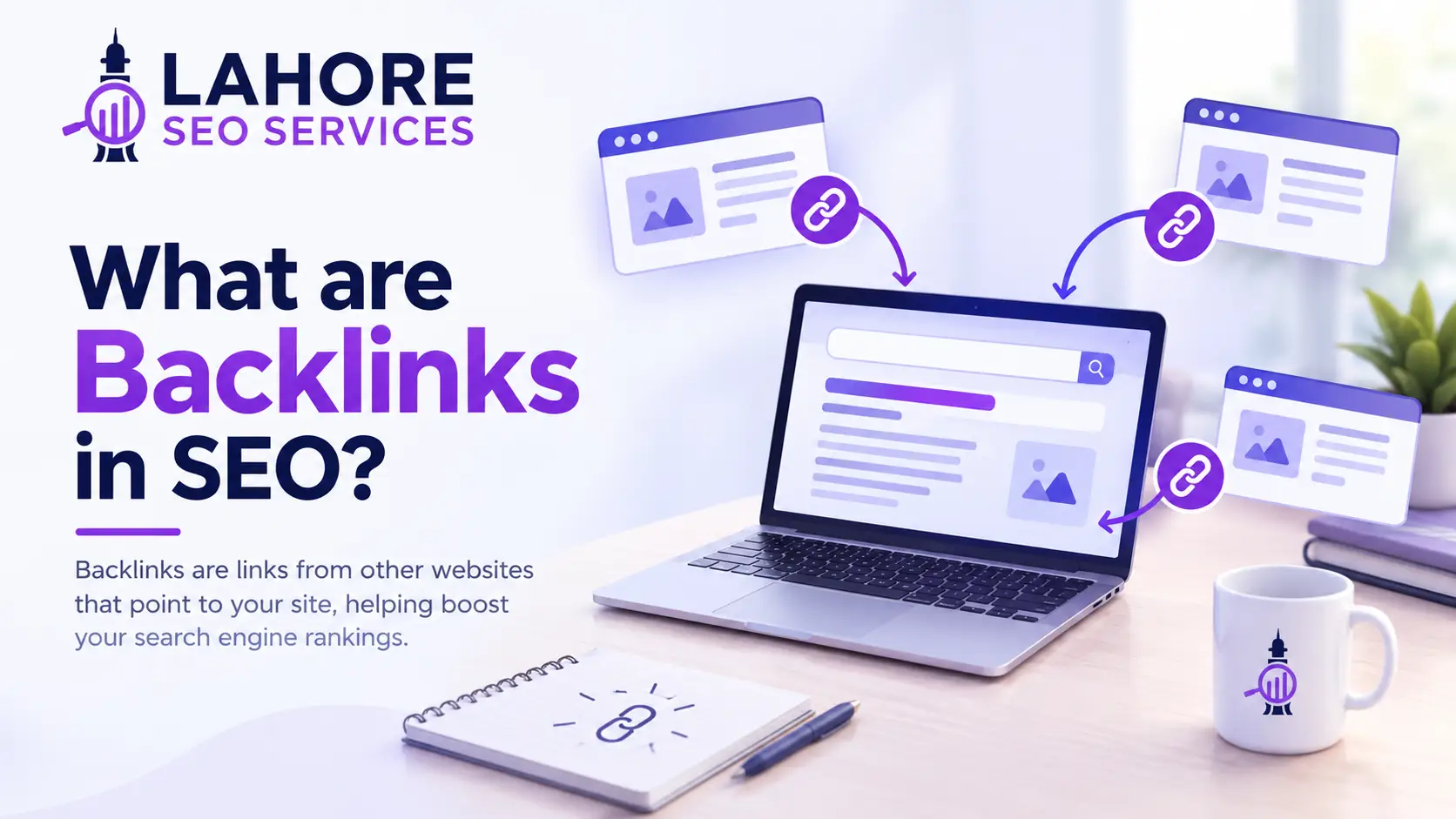
Backlinks in SEO are hyperlinks from one website to a page on another website. When an external website links to your website, the external link becomes a backlink for your site. Backlinks are also called inbound links or incoming links. Search engines use links to discover pages and evaluate relationships between websites, while users can click backlinks to reach useful resources. Backlink value depends on relevance, placement, context, attributes, and quality.
What Is a Backlink?
A backlink is an external hyperlink that points from a page on one domain to a page on another domain. For example, if an industry publication links to your service page within a relevant article, your service page receives a backlink. The linking website is the referring domain, while the destination is the linked page.
A backlink does not need to mention your business name. A relevant article can link to a product, service, research report, guide, category page, or homepage. The anchor text is the clickable wording used for the hyperlink. Natural anchor text helps readers understand the destination without forcing an exact keyword.
Backlinks differ from internal links. An internal link connects two pages on the same website, while a backlink comes from an external domain. Internal links support site navigation and distribute internal signals; backlinks establish connections between separate websites.
Why Are Backlinks Important for SEO?
Backlinks matter because relevant, credible links can support discovery, authority signals, referral traffic, and search visibility. Google has long used links as part of its systems for understanding the web, although rankings depend on numerous signals rather than backlinks alone.
A strong backlink can expose your content to a relevant audience. Visitors can click the link and arrive directly on your website, creating referral traffic. Search engines can use links to discover pages and understand relationships between resources. Editorial links from relevant websites can further demonstrate that other publishers consider a page useful enough to reference.
Backlinks become more valuable when the linking page is relevant, the link fits naturally within useful content, and the destination provides genuine value. Ten relevant referring domains can be more meaningful than hundreds of links generated from low-quality sources.
What Makes a Backlink High Quality?
A high-quality backlink comes from a relevant, trustworthy page and exists because the destination provides useful information or resources. Quality depends on context rather than a single third-party metric.
Important characteristics include:
- Relevance between the linking content and your destination page.
- A trustworthy and established referring website.
- Natural placement within useful editorial content.
- Descriptive, reader-focused anchor text.
- A destination page that directly satisfies the linked context.
- Potential to generate genuine referral traffic.
- A diverse backlink profile containing links from different relevant domains.
Third-party metrics can help with prospecting, but Google does not publish a universal Domain Authority score. Moz uses Domain Authority (DA), Ahrefs uses Domain Rating (DR), and Semrush uses Authority Score. These metrics are proprietary estimates, so use them for comparison rather than treating any score as a Google ranking factor.
Dofollow vs Nofollow Backlinks
Dofollow is the ordinary state of a link, while nofollow is a link attribute that tells search engines not to associate the link with your site in the same way as a normal link. The term “dofollow” is commonly used in SEO, but standard HTML links do not require a dofollow attribute.
A normal link can look like this:
<a href=”https://example.com/”>SEO services</a>
A nofollow link can include:
rel=”nofollow”
Google also recognizes rel=”sponsored” for paid or advertising links and rel=”ugc” for user-generated content. Nofollow, sponsored, and UGC attributes help communicate the nature of a link. A nofollow link can still generate referral traffic, exposure, and brand discovery.
Do not judge a backlink only by its attribute. A nofollow link from a highly relevant publication can deliver valuable visitors even when the link is not treated like a standard editorial link for ranking purposes.
Types of Backlinks in SEO
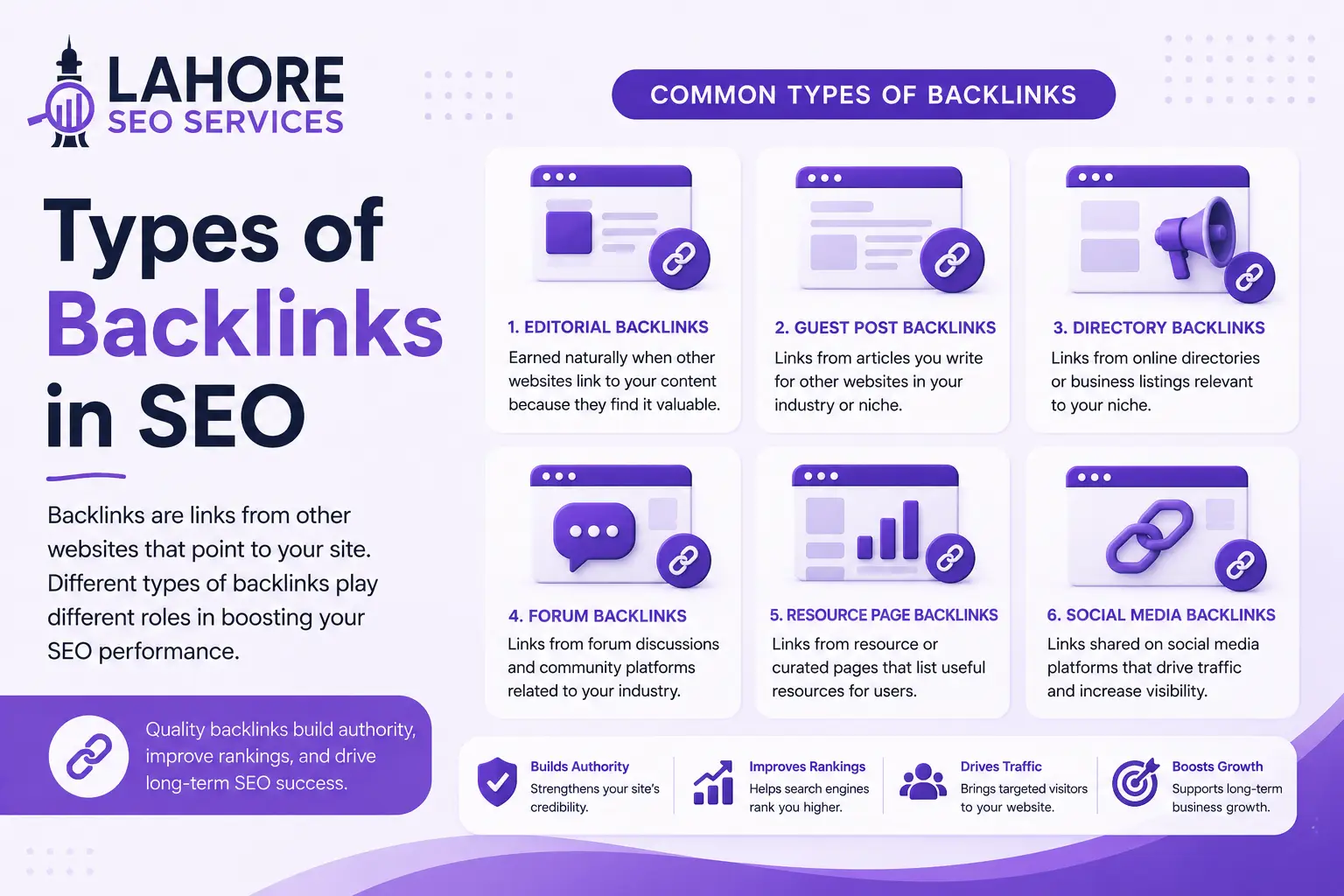
Backlinks can be classified by how they are earned, where they appear, and which link attributes they use. The following types are common in practical SEO campaigns.
Editorial Backlinks
Editorial backlinks occur when a publisher links to your content because the resource supports the publisher’s own article. Original research, statistics, detailed guides, tools, and strong reference pages can attract editorial links without direct requests.
Guest Post Backlinks
Guest post backlinks come from articles you contribute to another website. Guest posting can support visibility when the publication is relevant and the article provides genuine value. Publishing large volumes of low-quality guest posts primarily to obtain keyword-rich links creates an unnatural pattern.
Contextual Backlinks
Contextual backlinks appear within relevant body content rather than isolated sitewide areas. Context makes the relationship between the source and destination clearer to readers and search systems.
Profile and Citation Links
Profile backlinks can appear on legitimate business profiles, professional directories, associations, and industry platforms. Local businesses can use accurate citations to strengthen discoverability and provide customers with consistent business information. A directory link has value when the directory itself serves a genuine purpose.
Image Backlinks
An image backlink occurs when another website uses an image that links to your website or original asset. Original graphics, charts, photographs, and data visualizations can generate this type of link when publishers reference the source.
Nofollow, Sponsored, and UGC Links
These categories describe link attributes rather than separate acquisition methods. Nofollow can indicate that the publisher does not want to pass the same ranking association as a standard link. Sponsored identifies advertising or paid placements, while UGC identifies user-generated links.
Backlinks vs Internal and Outbound Links
A backlink points from an external website to your website, while an internal link connects pages within your own website and an outbound link points from your website to another domain.
| Link type | Direction | Primary purpose |
| Backlink | External site → your site | Referral, discovery, and SEO signals |
| Internal link | Your page → your page | Navigation and internal site relationships |
| Outbound link | Your site → external site | Citation, reference, or resource access |
Understanding the distinction prevents common SEO mistakes. Publishing another company’s article on your blog does not create a backlink for your business unless the external source links to your website. Simply copying industry content does not create authority.
How to Get High-Quality Backlinks
You can earn high-quality backlinks by creating link-worthy resources and promoting those resources to relevant publishers. The strongest process starts with content that gives another website a clear reason to cite your page.
Create original research, useful statistics, detailed tutorials, free calculators, templates, tools, industry studies, and definitive resources. These assets give publishers something specific to reference.
Use targeted outreach when a relevant publication has a reason to include your resource. Personalize outreach around the publisher’s existing content instead of sending mass requests.
Guest posting can work when you contribute original, expert content to a relevant publication. Keep the link editorially justified and avoid excessive exact-match anchor text.
Broken link building can recover opportunities where a relevant external page contains a dead resource. Identify the broken reference, create or identify a suitable replacement, and contact the publisher with a useful suggestion.
Unlinked brand mentions provide another opportunity. If a reputable website mentions your company, product, research, or author without linking to the relevant page, request a link when the link would help readers.
What Backlink Practices Should You Avoid?
Avoid link schemes designed primarily to manipulate search rankings. Buying links that pass ranking credit, creating excessive link exchanges, automated link placements, and spammy comment campaigns can create an unnatural backlink profile.
Do not purchase packages promising hundreds or thousands of backlinks. High-volume links from irrelevant or low-quality websites rarely provide the same value as relevant editorial references and can create cleanup problems.
Avoid excessive exact-match anchor text. A natural backlink profile contains varied wording that reflects how real publishers reference resources.
Do not place links in forums, comments, or communities solely for SEO. Community participation is useful when the contribution genuinely helps readers, but promotional link dropping can damage reputation and violate community rules.
How to Check Backlinks on a Website
Use Google Search Console and established backlink analysis platforms to examine links pointing to your website. Google Search Console provides a Links report for verified properties, while tools such as Ahrefs, Moz, and Semrush provide broader competitive and backlink analysis.
A backlink audit should examine the referring domain, linking page, destination URL, anchor text, link attribute, topical relevance, and estimated referral potential. Compare referring domains rather than focusing only on the total number of links.
Google Search Console is useful for first-party visibility into links Google has associated with your site. Third-party tools can expand analysis with competitor comparisons, historical data, referring-domain reports, anchor-text patterns, and link discovery.
For a single webpage, enter the exact URL into a backlink analysis tool when the platform supports page-level analysis. A browser’s source code can show hyperlinks present on a page, but source inspection does not reveal the complete external backlink profile of your own website.
What Is Authority in Backlinks?
Backlink authority describes the strength and credibility associated with a linking source, but Google does not assign websites a public universal authority score. SEO platforms calculate their own metrics from different datasets and formulas.
Relevance matters alongside authority. A highly established website outside your subject area may be less contextually useful than a respected specialist publication that covers your industry. The strongest prospects combine topical relevance, trustworthy editorial standards, useful audiences, and a reason to reference your page.
Referring-domain diversity matters because a backlink profile built across independent relevant websites can demonstrate broader recognition than repeated links from one domain. Quantity remains a useful descriptive measure, but quality and context determine whether a link is genuinely valuable.
How Backlinks Affect Rankings and Traffic
Backlinks can support rankings by contributing to the signals search engines use to evaluate pages, but backlinks do not guarantee a ranking position. Search visibility depends on content quality, relevance, technical accessibility, user intent, competition, internal linking, and other signals.
Referral traffic provides a direct way to evaluate link value. A link placed on a page with a relevant audience can send visitors who already have interest in your topic. Track referral sessions and conversions in your analytics platform to identify links that produce business value.
Track ranking trends, organic clicks, indexed pages, referral traffic, and conversions together. A backlink campaign becomes more useful when the campaign produces measurable improvements in qualified traffic and business outcomes.
Should You Disavow Bad Backlinks?
Do not disavow backlinks simply because an SEO tool labels a link as toxic. Google states that its systems can generally assess and ignore many irrelevant or low-quality links without requiring action from website owners.
The Disavow Links tool is intended for specific situations, particularly when a site has a substantial number of artificial or unnatural links and those links have caused or may cause a manual action. A third-party toxicity score alone is not sufficient evidence for disavowal.
Start with a backlink audit, identify genuine evidence of manipulative link activity, and attempt removal when appropriate. Use disavowal carefully because incorrect exclusions can remove links that you would otherwise want Google to consider.
How to Build a Sustainable Backlink Strategy
A sustainable backlink strategy combines useful content, relevant outreach, digital public relations, partnerships, and continuous backlink monitoring. Start by identifying pages that deserve external references, then create resources that solve specific information needs.
Prioritize quality over raw link counts. Build relationships with publishers, associations, journalists, suppliers, local organizations, and industry websites when genuine relevance exists. Promote original data and expert resources through outreach rather than asking every prospect for the same generic link.
Review new referring domains regularly and monitor anchor text, destination pages, referral traffic, and organic performance. Remove or address obvious manipulation instead of treating every low-quality link as an emergency.
For businesses in Lahore and other competitive markets, Lahore SEO Services can use backlink analysis to identify realistic link opportunities, evaluate competitor referring domains, and build outreach campaigns around relevant pages rather than arbitrary link quotas.
Frequently Asked Questions
Why are backlinks important for SEO?
Backlinks are important because relevant external links can support search discovery, authority signals, referral traffic, and visibility. Search engines evaluate many ranking signals, so backlinks work as one component of a broader SEO strategy rather than a standalone guarantee of higher rankings.
How do backlinks improve search engine rankings?
Backlinks can improve search rankings by helping search engines evaluate a page’s relationships, relevance, and external recognition. Strong, relevant links can support a page’s authority signals, while useful referral traffic creates additional value. Rankings still depend on content, intent, technical SEO, and competition.
What types of backlinks are best for SEO?
Editorial, relevant, naturally placed backlinks from trustworthy websites are generally the most valuable. Contextual links can provide strong relevance when the destination directly supports the surrounding content. Quality depends on the source, context, destination, and acquisition method, not merely the link attribute.
How can I get high-quality backlinks?
Create original resources that publishers have a reason to cite, then promote those resources through relevant outreach. Original research, statistics, tools, detailed guides, digital public relations, legitimate guest contributions, broken link opportunities, and unlinked brand mentions can generate relevant backlinks without relying on manipulative link schemes.
How many backlinks does a website need to rank?
There is no fixed backlink number that guarantees rankings. Required link strength varies by query competition, search intent, competing pages, topical authority, content quality, and site history. Compare relevant referring domains and link quality among pages ranking for your target queries rather than chasing a universal quantity.