Search engines have become much better at understanding topics, context, and user intent. Because of this, ranking for a single keyword is no longer the only goal. Your website also needs to show that it understands the wider subject.
This is where topical authority becomes important. It refers to how well a website demonstrates knowledge, relevance, and trust around a particular topic.
Instead of publishing disconnected articles, you build a network of useful content that answers different questions around the same subject. This can help improve organic visibility, build credibility, attract relevant links, and support visibility in AI-powered search.
What Does Topical Authority Mean?
Topical authority is the level of expertise and relevance a website demonstrates within a specific subject area.
For example, a website offering SEO services could publish detailed content about keyword research, technical SEO, content optimisation, search intent, internal linking, and link building. Covering these connected areas shows broader knowledge of SEO than publishing one or two unrelated articles.
The goal is not to publish hundreds of pages. It is to create useful, connected, and trustworthy content that covers important aspects of your chosen topic.
Topical authority is also different from domain authority. Domain authority is a third-party metric generally associated with a website’s overall link strength, while topical authority focuses on relevance and expertise within a particular subject.
How Does Topical Authority Work?
Search engines use many signals to understand whether content is relevant, useful, and trustworthy. A strong topical strategy helps create clear relationships between your pages and the subject you want to be known for.
Building Topic Depth and Coverage
Topic depth means covering important aspects of a subject rather than discussing it at a surface level.
For example, an SEO website could cover:
- Keyword research
- On-page SEO
- Technical SEO
- Local SEO
- Content strategy
- Search intent
- Link building
This combination gives the website both breadth and depth, allowing it to address different searches related to SEO.
Creating Topic Clusters and Semantic Relationships
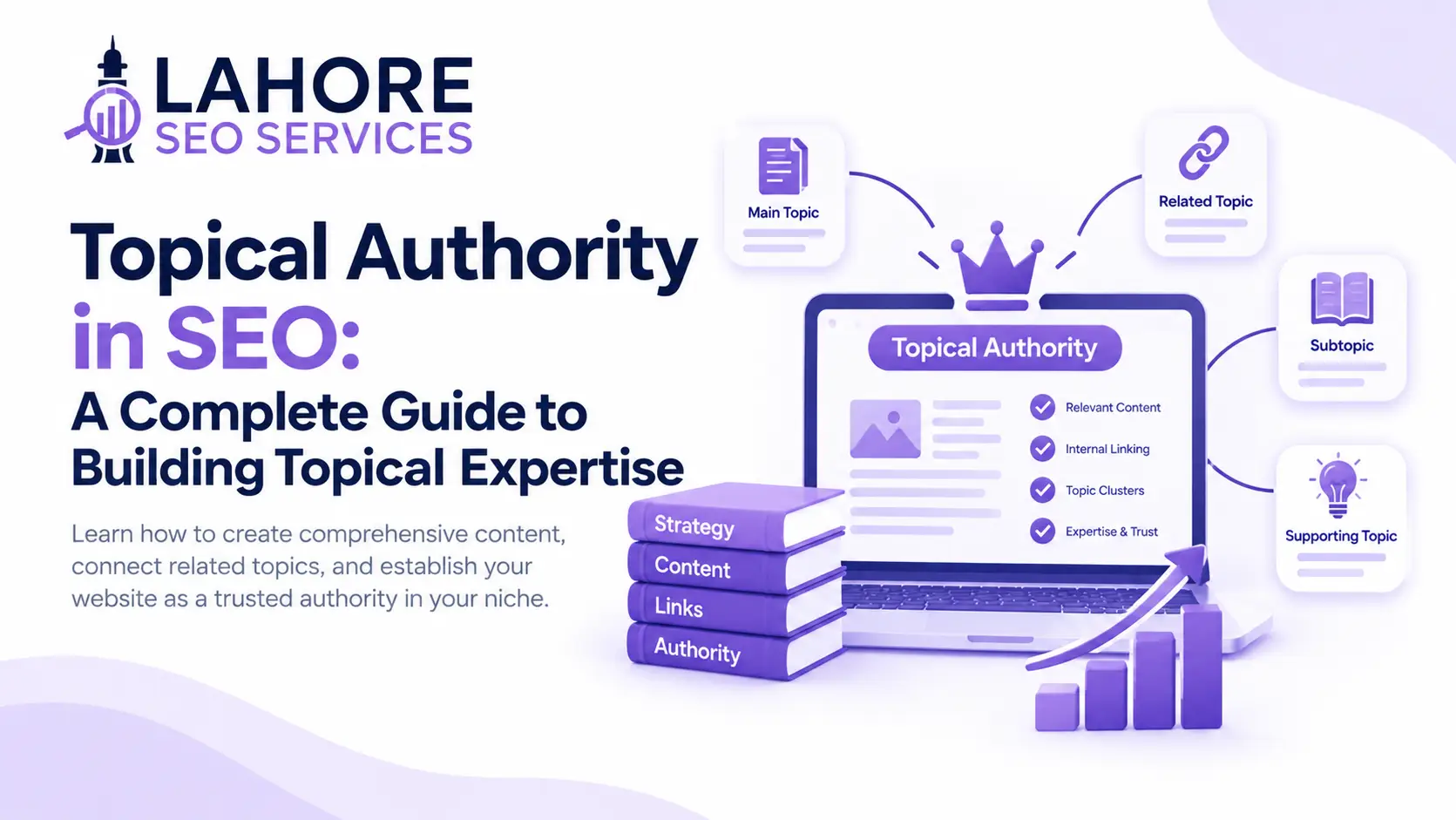
Topic clusters bring related content together around a central subject. A main pillar page provides an overview, while supporting pages explore specific questions or subtopics.
Internal links connect these pages and make the relationship between them clearer. Semantic relationships also matter because search engines can understand how different concepts are connected, even when they do not use exactly the same keywords.
Demonstrating E-E-A-T and Expertise
E-E-A-T stands for Experience, Expertise, Authoritativeness, and Trustworthiness.
It is not a single ranking score, but its principles are useful when creating credible content. Firsthand experience, accurate information, expert contributions, clear authorship, and trustworthy sources can all help demonstrate that your content is reliable.
Why Is Topical Authority Important for SEO?
Building topical authority can support several areas of your SEO strategy.
Increase Rankings and Organic Visibility
A website that covers a topic comprehensively can become relevant for many related searches. Instead of targeting one keyword, a content cluster can rank for numerous variations, questions, and long-tail searches.
This wider visibility can bring more organic traffic and help your website reach people at different stages of the search journey.
Establish Trust and Credibility
Consistently publishing useful information around one subject can strengthen your reputation with readers.
When people repeatedly find your website while researching related questions, they may begin to associate your brand with that subject. Over time, this can support stronger credibility and brand recognition.
Attract Relevant Backlinks
High-quality content can naturally earn backlinks when other websites find it useful enough to reference.
Detailed guides, original research, useful statistics, expert insights, and practical resources can all attract links. However, relevance and quality are more important than simply collecting a large number of backlinks.
Strengthen AI Search Visibility
Topical authority is also relevant to AI-powered search experiences.
AI systems need reliable information to generate useful answers. Websites that provide comprehensive coverage, clear structure, relevant context, and credible information may have more opportunities to be referenced or cited in AI-generated responses.
How Do Search Engines Assess Topical Authority?
There is no single public Google metric that tells you the topical authority of a website. Instead, search engines use different systems and signals to understand relevance, content quality, context, and usefulness.
Understanding Semantic Search and Search Intent
Modern search engines try to understand what a user means rather than simply matching individual words.
For this reason, content should address the actual purpose behind a search. Someone searching for “how to build topical authority” is looking for practical guidance, not just a definition.
Understanding search intent helps you create content that answers the user’s real question.
How Google Has Evolved in Understanding Topics
Google has introduced several major improvements to how its systems understand language and queries.
Hummingbird helped Google better understand the meaning behind searches. RankBrain brought machine learning into query interpretation, while BERT improved Google’s ability to understand words in context and their relationships within a query.
These developments helped move search beyond simple keyword matching toward a deeper understanding of meaning and intent.
Helpful Content, Experience, and E-E-A-T
Search engines increasingly emphasise content that provides genuine value to users.
Your content should be created to answer questions, solve problems, and provide accurate information rather than simply manipulate rankings. Demonstrating real experience and expertise can also make your content more useful and trustworthy.
How to Build Strong Topical Authority
Topical authority does not happen overnight. It develops through consistent content creation, strong site structure, and genuine expertise.
Select a Focused Subject
Start with a topic that closely matches your business, audience, and expertise.
A focused niche makes it easier to build meaningful content relationships. Trying to cover too many unrelated subjects can make your website less focused.
Research Related Keywords and Subtopics
Do not stop at one primary keyword. Research related searches, questions, long-tail keywords, entities, and different search intents.
Competitor research can also reveal important subtopics that your website has not covered yet. Tools such as Ahrefs, Semrush, and Ubersuggest can help identify opportunities and content gaps.
Develop Pillar Pages and Supporting Content
Create comprehensive pillar pages for your main subjects. Then build supporting articles around specific questions and subtopics.
For example, a pillar page about SEO could link to detailed articles about keyword research, technical SEO, internal linking, search intent, and eCommerce SEO.
This creates a logical content structure that helps both users and search engines understand your website.
Publish Comprehensive and Useful Content
Longer content is not automatically better. The priority should be usefulness and completeness.
Answer important questions, explain concepts clearly, use accurate information, and add original examples or insights where possible. Avoid producing thin pages simply because you found another keyword to target.
Create a Strong Internal Linking Structure
Internal links connect related pages across your website.
Link supporting content to relevant pillar pages and connect closely related articles where it helps the reader. Use descriptive anchor text so users understand what they will find when they click.
Earn Relevant and High-Quality Backlinks
Focus on earning links from trustworthy websites that are relevant to your industry.
Digital PR, original research, expert contributions, useful resources, and genuine brand mentions can help attract relevant backlinks. A small number of valuable links can be more useful than many unrelated ones.
Include Firsthand Experience and Expert Insights
Real experience can make content more useful and credible.
Where appropriate, include practical examples, case studies, expert opinions, original observations, or insights from subject matter experts. Clear authorship can also help readers understand who created the information.
Update and Refresh Existing Content
A strong content library needs regular maintenance.
Statistics can change, tools may be updated, and new questions can emerge. Review important pages periodically and refresh outdated information. Content gap research can also help you identify new areas to add to existing topic clusters.
How Can You Measure Topical Authority?
Because there is no universal topical authority score, use several SEO signals together.
Track Keyword Rankings and Topic Coverage
Monitor how many relevant keywords your website ranks for and whether visibility is expanding across your important topic clusters.
Monitor Internal Links and Backlinks
Check whether related pages are properly connected and whether your content is earning backlinks from relevant websites.
Measure Organic Search Traffic
Growing organic traffic from a wider range of related searches can indicate that your website is gaining stronger topical coverage.
Track AI and LLM Citations
Mentions or citations within AI-powered search tools can provide another visibility signal. However, these should not be treated as a definitive measurement of topical authority.
Common Mistakes That Weaken Topical Authority
Several mistakes can prevent a website from developing strong topical relevance.
- Publishing content about unrelated subjects
- Creating thin or low-value pages
- Targeting keywords without understanding search intent
- Focusing only on search volume
- Publishing content mainly for quantity
- Building irrelevant backlinks
- Failing to connect related pages with internal links
- Allowing important content to become outdated
The goal should always be to build a focused and useful resource rather than simply increase the number of URLs on your website.
Conclusion
Topical authority is about becoming a reliable resource for a specific subject. It goes beyond targeting individual keywords and focuses on creating connected content that demonstrates knowledge, relevance, and trust.
Start with a focused topic, research its related subtopics, create useful pillar and supporting pages, strengthen internal linking, earn relevant backlinks, and add genuine expertise to your content.
The objective is simple: do not just publish content about a topic. Build a website that genuinely helps people understand it.
Frequently Asked Questions
How do you build topical authority?
Choose a focused subject, research related topics and search intents, create useful pillar and supporting content, connect pages with internal links, earn relevant backlinks, and demonstrate genuine expertise.
Is topical authority the same as domain authority?
No. Topical authority focuses on expertise and relevance within a specific subject. Domain authority is a third-party metric generally used to estimate a website’s overall link strength.
Do backlinks help build topical authority?
Yes. Relevant, high-quality backlinks can support credibility and SEO performance. However, backlinks alone do not create topical authority. Content quality, relevance, internal linking, and expertise also matter.
Does topical authority improve AI search visibility?
It can. Comprehensive, well-structured, and trustworthy content may have a better chance of being referenced by AI-powered search systems, although there is no guaranteed citation or universal AI authority score.