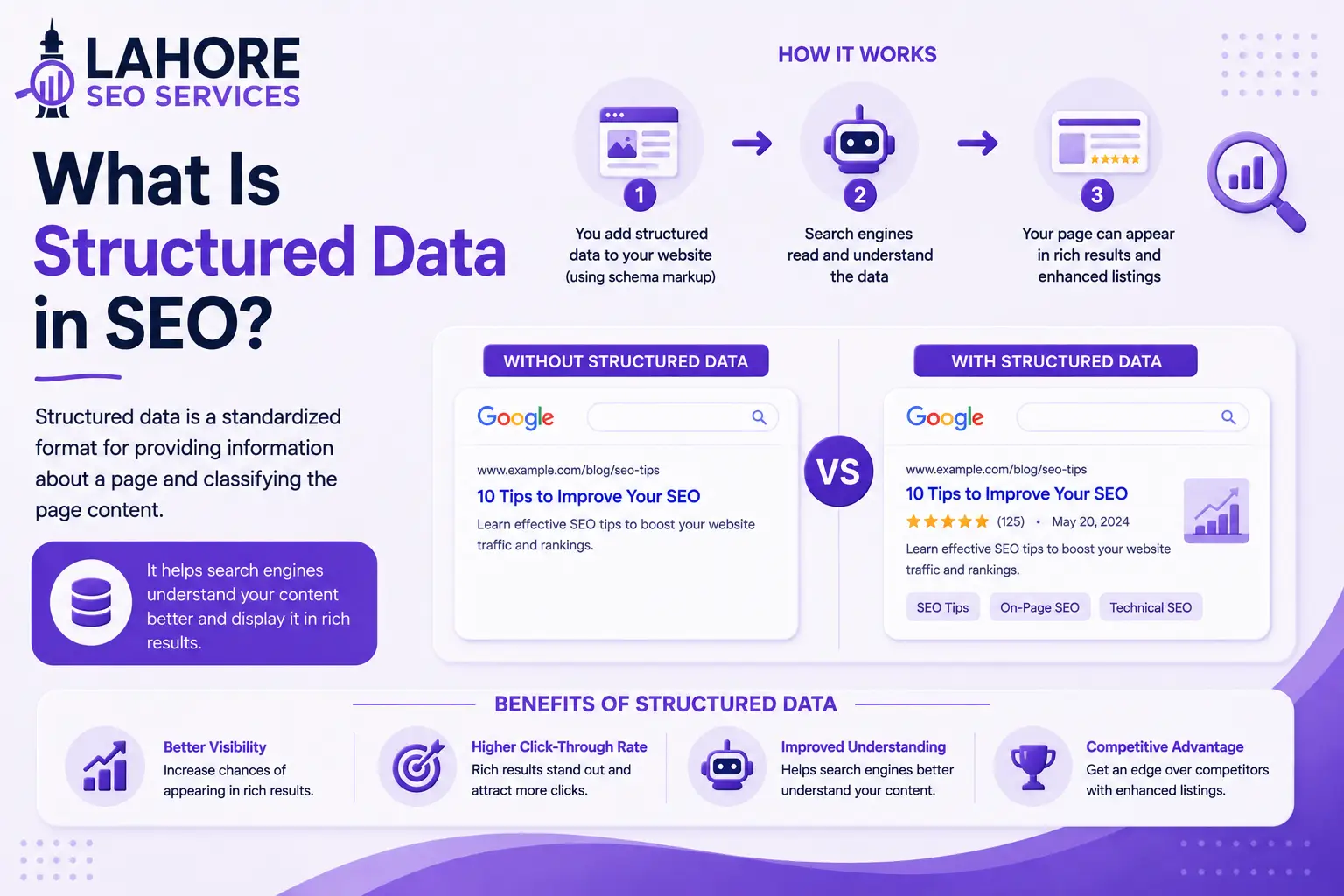
Structured data in SEO is machine-readable markup that gives search engines information about webpage content. You can identify products, organizations, articles, events, services, reviews, breadcrumbs, and other entities. Structured data does not guarantee higher rankings, but correct implementation can support clearer interpretation and rich-result eligibility.
For businesses, structured data connects information with a standardized vocabulary. Lahore SEO Services can use markup to clarify business details, services, articles, and entity relationships. Effective implementation requires accurate schema, validation, and monitoring.
What Is Structured Data?
Structured data is organized information presented in a standardized, machine-readable format. On a webpage, structured data labels specific facts so search engines can understand what a page contains without relying only on visible text.
A product page, for example, can identify a product name, brand, description, price, availability, and review information. An article can identify the headline, author, publication date, image, and main entity. A local business page can identify the business name, address, telephone number, opening hours, URL, and location.
Structured data differs from structured content. Structured content organizes publishing components, while structured data adds machine-readable meaning. Both approaches support a clearer content infrastructure.

What Is Schema.org?
Schema.org is a shared vocabulary for describing entities and properties in structured data. Schema.org defines terms such as Product, Organization, Article, Event, LocalBusiness, Review, and BreadcrumbList.
Structured data is the broader concept, while Schema.org provides a vocabulary that you can use to describe webpage entities. The distinction matters because JSON-LD, Microdata, and RDFa are implementation formats, whereas Schema.org supplies the semantic definitions.
Google supports structured data under specific documentation and eligibility requirements. Schema.org contains more types and properties than Google uses for every rich-result feature, so select markup based on the actual page and supported features.
Why Is Structured Data Important for SEO?
Structured data helps search engines interpret webpage content more precisely and can make eligible pages available for rich results. Search engines still evaluate the page itself, so structured data does not replace useful content, crawlability, indexability, relevance, or technical SEO.
Correct markup provides explicit context about entities and relationships. A search engine can identify that a number represents a product price, that a date represents an event start date, or that a name identifies an organization.
Structured data can support enhanced search appearances when a page meets the relevant requirements. Rich results can display additional information such as product prices, ratings, availability, event details, recipe information, or breadcrumbs.
Structured data should form part of a broader SEO strategy, not operate as an isolated ranking tactic.
How Does Structured Data Work?
Structured data works by adding markup that identifies the type of information present on a webpage. Search engines crawl the page, process the markup, compare the structured information with visible content and other signals, and determine whether the page qualifies for supported search features.
JSON-LD is a common implementation format. JSON-LD places structured information in a script element without requiring you to add attributes throughout visible HTML. Microdata adds semantic attributes directly to HTML elements, while RDFa uses HTML attributes to express relationships and properties.
The markup must accurately represent content users can access. Unsupported, hidden, misleading, or inaccurate information can prevent eligibility and create structured-data issues.
What Is a Structured Data Example?
A structured data example is JSON-LD that identifies a webpage entity and its properties. For a product page, Product Schema can identify the product name, description, brand, image, offers, price, availability, and aggregate rating when those details genuinely exist.
A simplified example looks like this:
<script type=”application/ld+json”>
{
“@context”: “https://schema.org”,
“@type”: “Product”,
“name”: “Example Product”,
“description”: “Product description”,
“offers”: {
“@type”: “Offer”,
“price”: “99.00”,
“priceCurrency”: “USD”,
“availability”: “https://schema.org/InStock”
}
}
</script>
The example demonstrates the relationship between the format and vocabulary. JSON-LD provides the structure, while Schema.org defines Product, Offer, price, availability, and related properties. Production markup must use factual information from the actual page.
What Are the Main Types of Structured Data in SEO?
The appropriate schema type depends on the content and purpose of the page. Common types include Organization Schema, LocalBusiness Schema, Article Schema, Product Schema, Event Schema, BreadcrumbList, Review Schema, FAQ Schema, HowTo Schema, and VideoObject Schema.
Organization Schema can describe a company or organization. LocalBusiness Schema can describe a qualifying local business and relevant business information. Article Schema can identify article properties such as headline, author, date, and image.
Product Schema supports product information, while Event Schema describes events and their dates and locations. BreadcrumbList can clarify navigational hierarchy. VideoObject can describe video properties such as title, description, thumbnail, and upload date.
Not every page needs every schema type. Select markup that accurately describes the page and supports a relevant search feature.
Structured Data and Rich Results
Rich results are enhanced search-result presentations that can show additional information beyond a standard listing. Structured data can make a page eligible for certain rich-result features, but eligibility does not guarantee that Google will display a rich result for every query.
For ecommerce websites, valid product markup can provide information such as price, availability, ratings, and reviews when Google supports the relevant feature and the page meets its requirements. Event markup can support event-related search presentations. Article and breadcrumb markup can provide additional machine-readable context.
Rich results can make search listings more informative. Measure actual impressions and clicks rather than assume that markup automatically produces a specific CTR increase.
Does Structured Data Improve Rankings?
No. Structured data is not a direct guarantee of higher organic rankings. Google can use structured data to understand content and qualify pages for rich results, but correct markup does not automatically move a page to a higher position.
Ranking depends on broader signals that include relevance, content quality, technical accessibility, links, page experience, search intent, and other systems. Structured data supports understanding and search-feature eligibility, not guaranteed ranking improvement.
Avoid adding extensive schema while neglecting content quality or technical problems. Structured data works best when the page provides accurate, useful, accessible information.
Structured Data for Semantic SEO and Entity SEO
Structured data can support Semantic SEO by explicitly identifying entities, properties, and relationships. Entity SEO focuses on helping search engines understand distinct entities and how entities relate within a website and across trusted sources.
An organization can connect its name, website, logo, social profiles, contact information, and other relevant properties through appropriate markup. A service page can identify the service and provider when the relationship accurately reflects the visible page.
This structure makes website information more consistent and machine readable. Structured data does not create authority by itself or prove expertise and trust.

Structured Data and AI Search
Structured data can provide additional machine-readable context for systems that retrieve and interpret web information. Search experiences that use artificial intelligence can process structured information alongside page content, links, and other signals.
Generative engine optimization (GEO) focuses on making content easier for generative systems to retrieve, interpret, and use. Structured data can support entity recognition and retrievability because explicit labels provide information about the meaning of page elements.
Schema does not guarantee inclusion in ChatGPT, Gemini, AI Overviews, or other generative systems. AI systems use multiple sources and retrieval mechanisms. Structured data is one component of a broader technical and content strategy.
How to Add Structured Data to a Website
To add structured data, first identify what the page represents. Choose a relevant Schema.org type, select properties supported by the page, generate JSON-LD or another supported format, place the markup correctly, and validate the implementation.
Follow these practical steps:
- Identify the page entity and primary purpose.
- Select an appropriate Schema.org type.
- Add factual properties that appear on the page.
- Implement JSON-LD where suitable.
- Validate the markup.
- Publish and inspect the live URL.
- Monitor search performance and detected issues.
WordPress users can implement basic schema through SEO plugins such as Rank Math or through custom JSON-LD. Plugin-generated markup still requires review because automatic output can become inaccurate when page templates, business details, or content change.
How to Test Structured Data for SEO
To test structured data, use Google’s Rich Results Test for supported rich-result eligibility and Schema.org’s Schema Markup Validator for broader schema validation. Google Search Console can then help you monitor eligible enhancement reports and detected issues for supported features.
Testing should happen before and after deployment. Validate the generated code, inspect the live URL, check that required properties exist, confirm that values match visible content, and review warnings or errors that affect eligibility.
A successful test does not guarantee a rich result. Validation identifies technical issues; search engines still decide whether and how structured data appears.

Common Structured Data Mistakes
The most damaging structured-data mistakes involve inaccurate information, irrelevant schema, missing required properties, and markup that does not match visible page content.
Do not add Product Schema to a general service page, use Review Schema for reviews that do not meet the relevant requirements, or create Organization properties from information that the website does not support.
Avoid generating identical markup across pages when entity details differ. Check canonical URLs, names, prices, availability, dates, authors, images, and other properties for accuracy.
Do not assume that every Schema.org type produces a Google rich result. Schema.org vocabulary and Google-supported search features are related but not identical.
How to Monitor Structured Data Performance
Monitor structured data through Google Search Console, the Rich Results Test, and your website’s technical SEO process. Search Console can surface supported enhancement issues and provide information about affected URLs.
Track organic impressions, clicks, search appearance data where available, indexed pages, and relevant business conversions. Compare performance before and after implementation only when the comparison accounts for other changes that could affect search results.
Review schema after changes to prices, products, services, authors, business information, event dates, or templates. Valid markup can become inaccurate after updates.
How Structured Data Fits Into Your SEO Strategy
At Lahore SEO Services, structured data should support a page-level SEO strategy that begins with search intent and content quality. Determine the page purpose first, then identify the entity, schema type, properties, internal links, and search features that genuinely fit the page.
A local SEO service website may use Organization or LocalBusiness markup for appropriate business information, Service-related structured data where applicable, BreadcrumbList for hierarchy, and Article Schema for educational content. An ecommerce website may prioritize Product markup on eligible product pages.
The strongest implementation is accurate, selective, and maintained. More markup does not automatically create more SEO value. Give search engines reliable information that matches the page and site’s entity structure.
Frequently Asked Questions
How does structured data help with SEO?
Structured data helps SEO by giving search engines explicit information about webpage entities, properties, and relationships. Correct markup can support content understanding and eligibility for rich results, while the underlying page still needs relevant, accessible, useful content to rank effectively.
What is a structured data example?
A structured data example is JSON-LD Product Schema that identifies a product name, description, brand, price, availability, and other factual properties. The markup gives search engines machine-readable context that complements the information users can see on the product page.
What are the different types of structured data in SEO?
Common structured data types include Product, Article, Organization, LocalBusiness, Event, BreadcrumbList, Review, FAQ, HowTo, and VideoObject. You should select a schema type according to the actual content, page purpose, supported search features, and information visibly available to users.
How to add structured data to a website?
To add structured data, identify the page type, select the appropriate Schema.org vocabulary, create accurate JSON-LD markup, add the code to the page, and validate the result. WordPress users can implement schema through suitable plugins or custom code with technical review.
How to test structured data for SEO?
To test structured data, use Google’s Rich Results Test for supported rich-result eligibility and Schema.org’s Schema Markup Validator for general schema validation. Inspect the live URL after deployment, resolve relevant errors, and monitor supported structured-data reports in Google Search Console.